
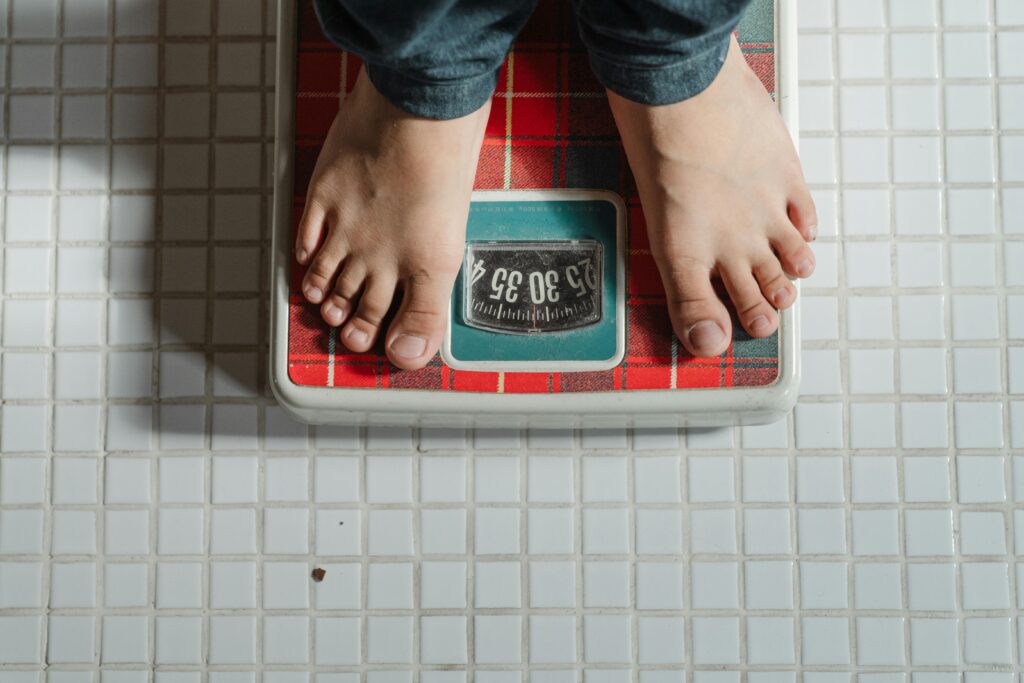
What is my ideal weight? It is one of the most searched questions in health and fitness — and one of the most misunderstood. Your ideal weight is not a single number but a healthy range based on your height, gender, and body frame. In this guide Maya and Robin discover their ideal weight ranges and what that means for their health journeys.
Maya — 38 Years Old, 160cm, 80kg
Maya had always assumed her ideal weight was whatever she weighed in her 20s — around 58kg. But was that actually healthy for her height and frame? She decided to find out properly using a science-backed formula rather than guessing.
Robin — 20 Years Old, 186cm, 60kg
Robin knew he was underweight but had no idea what weight he should actually be aiming for. His friends told him to aim for 80kg, his gym trainer said 75kg — he needed a proper scientific answer rather than guesswork.
What is the ideal weight for my height?
Ideal weight — also called healthy weight or target weight — is the range of body weight associated with the lowest risk of weight-related health problems for a given height. It is not about appearance or aesthetics. It is about the weight range at which your body functions most efficiently and your health risks are minimised.
Importantly ideal weight is a range — not a single number. A healthy person of 170cm might have an ideal weight anywhere from 57kg to 70kg depending on their body frame, muscle mass, age and gender.
Research reference: Several validated formulas exist for calculating ideal body weight. The most widely used in clinical practice are the Devine formula (1974) — originally developed for drug dosing calculations — and the Hamwi formula (1964). Both have been validated extensively in clinical research and are used by healthcare professionals worldwide.
Source: Devine BJ. Gentamicin therapy. Drug Intelligence and Clinical Pharmacy. 1974. Hamwi GJ. Therapy: changing dietary concepts. American Diabetes Association. 1964.
How is Ideal Weight Calculated?
Our ideal weight calculator uses the Devine formula — the most widely used formula in clinical practice internationally. Here is how it works:
Devine Formula:
Men: Ideal weight (kg) = 50 + 2.3 × (height in inches − 60)
Women: Ideal weight (kg) = 45.5 + 2.3 × (height in inches − 60)
Our calculator then applies a ±5% adjustment based on your body frame size (small, medium, or large) to give you a personalised range.
Maya’s Ideal Weight
Maya is 160cm tall (63 inches) with a medium body frame. Let us calculate her ideal weight range.
Maya’s Ideal Weight Calculation:
Ideal weight = 45.5 + 2.3 × (63 − 60)
Ideal weight = 45.5 + 2.3 × 3
Ideal weight = 45.5 + 6.9 = 52.4kg (base)
With ±5% frame adjustment: 50kg to 55kg
What this means for Maya: Maya’s ideal weight range is 50 to 55kg. She currently weighs 80kg — meaning she is 25 to 30kg above her ideal weight range. Her realistic first milestone target is to reach 65kg — a weight that sits just above the ideal range but dramatically reduces her health risks compared to 80kg.
Maya was surprised — she had assumed her ideal weight was 58kg (what she weighed at 25) but the formula suggested her true ideal range was actually 50 to 55kg for her height. This gave her a clearer long-term target to work toward.
Robin’s Ideal Weight
Robin is 186cm tall (73.2 inches) with a medium body frame. Let us calculate his ideal weight range.
Robin’s Ideal Weight Calculation:
Ideal weight = 50 + 2.3 × (73.2 − 60)
Ideal weight = 50 + 2.3 × 13.2
Ideal weight = 50 + 30.4 = 80.4kg (base)
With ±5% frame adjustment: 76kg to 84kg
What this means for Robin: Robin’s ideal weight range is 76 to 84kg. He currently weighs only 60kg — meaning he is 16 to 24kg below his ideal weight range. His goal weight of 75 to 80kg is well within reach with consistent training and adequate nutrition over 12 to 18 months.
Robin’s friends had told him to aim for 80kg — which turned out to be exactly right according to the formula! His gym trainer’s suggestion of 75kg was also within the healthy range for his large frame.
Ideal Weight by Height — Reference Table
Here is a quick reference table for ideal weight ranges based on the Devine formula for medium frame adults:
| Height | Ideal Weight — Women | Ideal Weight — Men |
|---|---|---|
| 150cm (4’11”) | 43 – 47kg (95–104 lbs) | 48 – 52kg (106–115 lbs) |
| 155cm (5’1″) | 46 – 51kg (101–112 lbs) | 51 – 56kg (112–123 lbs) |
| 160cm (5’3″) | 50 – 55kg (110–121 lbs) | 54 – 59kg (119–130 lbs) |
| 165cm (5’5″) | 53 – 58kg (117–128 lbs) | 57 – 63kg (126–139 lbs) |
| 170cm (5’7″) | 56 – 62kg (123–137 lbs) | 61 – 67kg (134–148 lbs) |
| 175cm (5’9″) | 59 – 65kg (130–143 lbs) | 64 – 71kg (141–157 lbs) |
| 180cm (5’11”) | 62 – 69kg (137–152 lbs) | 68 – 75kg (150–165 lbs) |
| 185cm (6’1″) | 66 – 73kg (145–161 lbs) | 72 – 79kg (159–174 lbs) |
| 190cm (6’3″) | 69 – 76kg (152–168 lbs) | 75 – 83kg (165–183 lbs) |
How to Determine Your Body Frame Size
Your body frame size — small, medium, or large — significantly affects what your ideal weight should be. Here is a simple way to determine your frame size using wrist circumference:
| Gender | Small Frame | Medium Frame | Large Frame |
|---|---|---|---|
| Women (height under 157cm) | Wrist under 14cm | 14–14.6cm | Over 14.6cm |
| Women (height over 157cm) | Wrist under 15.2cm | 15.2–16.5cm | Over 16.5cm |
| Men | Wrist under 16.5cm | 16.5–19cm | Over 19cm |
Limitations of Ideal Weight Formulas
Like BMI ideal weight formulas have important limitations. They do not account for:
- Muscle mass — A bodybuilder may weigh well above their ideal weight range yet have extremely low body fat and excellent health
- Age-related changes — Bone density and muscle mass change with age affecting what a healthy weight looks like
- Ethnicity — Different ethnic groups have different body compositions at the same weight and height
- Individual variation — Two people of identical height and frame can have very different healthy weight ranges based on their unique physiology
Use ideal weight as a guideline and starting point — not as an absolute target. Combine it with BMI and body fat percentage for a complete picture of your health.
How to Reach Your Ideal Weight
Whether you need to lose weight like Maya or gain weight like Robin the approach is the same — calculate your calorie target, prioritise protein, and be consistent over time.
If you need to lose weight (like Maya)
- Calculate your TDEE using our free calculator
- Eat 300 to 500 calories below TDEE
- Aim for 1.6g protein per kg body weight
- Add 30 minutes of walking daily
- Expect 0.25 to 0.5kg loss per week
If you need to gain weight (like Robin)
- Calculate your TDEE using our free calculator
- Eat 200 to 300 calories above TDEE
- Aim for 2g protein per kg body weight
- Do strength training 3 to 4 times per week
- Expect 0.25 to 0.5kg gain per week
Maya and Robin — Progress Update
After 6 months of following their personalised plans based on their ideal weight targets:
Maya has gone from 80kg to 73kg — still above her ideal range of 50 to 55kg but significantly healthier. Her blood pressure has improved, her energy levels are much better, and she is well on track toward her long-term goal.
Robin has gone from 60kg to 68kg — approaching the lower end of his ideal range of 76 to 84kg. He is stronger than ever, his BMI is now in the healthy range, and he has another 8 to 16kg to gain to reach his full ideal weight range.
Find Your Ideal Weight Right Now
Use our free Ideal Weight Calculator — enter your height, gender and frame size for your personalised healthy weight range in seconds. Supports both metric and imperial units.
Calculate My Ideal Weight Free →The Bottom Line
Ideal weight is not a single number — it is a healthy range that depends on your height, gender, and body frame. Maya’s ideal weight range is 50 to 55kg for her 160cm height. Robin’s ideal weight range is 76 to 84kg for his 186cm height.
Neither of them is at their ideal weight yet — but both are making consistent progress toward it. Use your ideal weight as a target to aim for, not a source of stress. Any movement toward your ideal range — even partial — brings real health benefits.
References
- Devine BJ. Gentamicin therapy. Drug Intelligence and Clinical Pharmacy. 1974;8:650-655.
- Hamwi GJ. Therapy: changing dietary concepts. In: Danowski TS, ed. Diabetes Mellitus: Diagnosis and Treatment. American Diabetes Association. 1964.
- Robinson JD, et al. Determination of ideal body weight for drug dosage calculations. American Journal of Hospital Pharmacy. 1983;40(6):1016-1019.
📖 Related Articles
Disclaimer: Maya and Robin are fictional characters created for educational purposes. This article is for informational purposes only and does not constitute medical advice. Always consult a qualified healthcare professional for personal health guidance.