
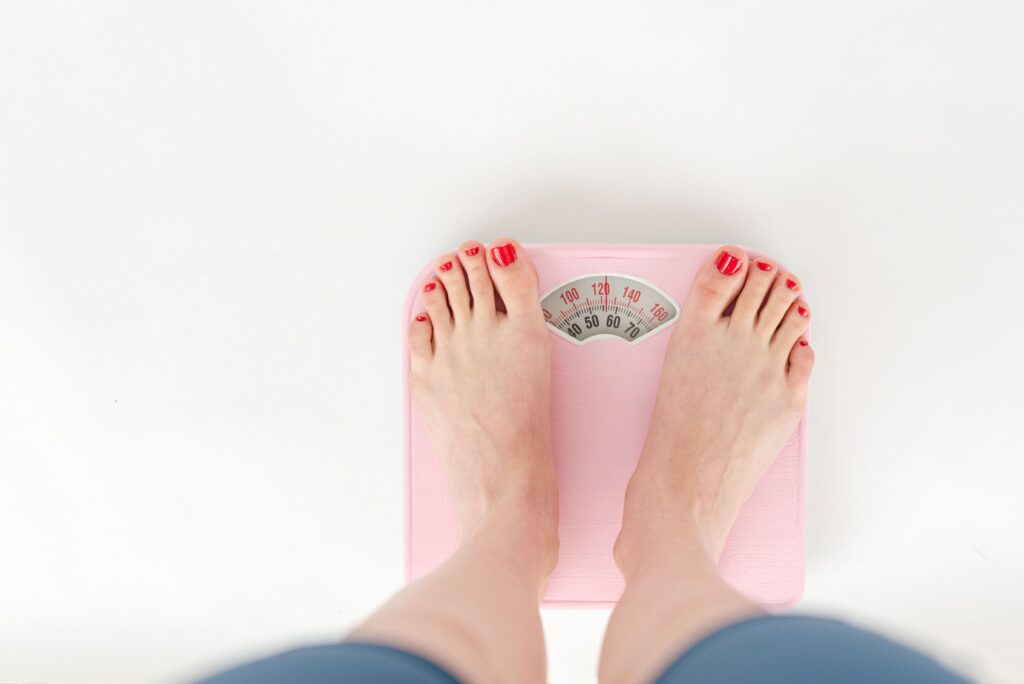
You are tracking your calories. You are in a deficit on paper. And yet the scale refuses to move. This is one of the most frustrating experiences in fitness — and also one of the most common. The good news is there is almost always a specific, fixable reason behind it. We follow Maya as she investigates exactly why her weight loss stalled.
Maya — 38 Years Old, 160cm (5’3″), Started at 80kg (176 lbs)
Maya had been eating 1,492 calories a day for three weeks straight, logging everything in her app. Her TDEE calculator said she should be in a 500 calorie deficit. But the scale showed exactly the same number it had three weeks ago: 80kg. She was doing everything “right” — or so she thought.
⚡ Most Likely Reasons
- You are underestimating how much you actually eat
- Your “deficit” is based on the wrong calorie target
- Water retention is masking real fat loss
- You are not accounting for weekends or social eating
- Your activity level has dropped without you noticing
1. You Are Probably Eating More Than You Think
This is, by far, the most common reason. Research consistently shows people underestimate their calorie intake — often significantly.
- Cooking oil is one of the biggest hidden sources — a single tablespoon (about 14g / 0.5oz) is 120 calories
- Sauces, dressings and condiments add up fast and are rarely logged accurately
- Weekend eating is often not tracked the same way as weekdays
- Tasting food while cooking adds calories that never get logged
- Eyeballing portions instead of weighing food leads to consistent underestimation
Fix:
- Use a digital food scale (grams/kg or oz/lbs) for at least 2 weeks to recalibrate your portion sense
- Log oils, sauces and drinks — not just main meals
- Track weekends with the same discipline as weekdays
2. Your Calorie Target May Be Wrong
A “deficit” only works if it is actually below your real maintenance calories. Many people use generic online calculators that overestimate their TDEE significantly.
- Activity level dropdowns are often overstated — “moderately active” gets selected by people who barely exercise
- Muscle mass affects metabolism — two people with the same weight (e.g. 70kg / 154lbs) can have very different BMRs
- Metabolic adaptation means your maintenance calories drop as you lose weight, but most people never recalculate
Fix:
- Recalculate your TDEE every time you lose 5kg (about 11 lbs)
- Be conservative when picking your activity level — most people overestimate
- If weight has not moved in 3 weeks of consistent tracking, your deficit is smaller than you think — reduce calories by another 100-200
3. Water Retention is Hiding Your Progress
Fat loss and the number on the scale are not the same thing. Water retention can easily mask 1-2kg (2-4 lbs) of real fat loss for days or even weeks.
- High sodium meals cause temporary water retention lasting 2-3 days
- New or intense exercise causes muscle inflammation and water retention for up to a week
- Hormonal cycles in women can cause 1-3kg (2-6 lbs) of water weight fluctuation
- High carbohydrate meals after a low carb period cause temporary water retention as glycogen stores refill
Fix:
- Weigh yourself daily at the same time and look at the weekly average — not single day readings
- Track waist measurement (cm or inches) alongside weight — it is less affected by water fluctuations
- Give any new diet or exercise routine at least 3 weeks before judging results
4. Weekends Are Quietly Cancelling Your Deficit
This is the silent killer of weight loss progress. A perfect 500 calorie deficit Monday to Friday gets completely wiped out by two unlogged weekend meals.
- One restaurant meal can easily contain 1,200 to 1,800 calories
- Alcohol adds calories and also lowers inhibition around food choices
- Social eating occasions are rarely tracked with the same accuracy as home meals
Fix:
- Estimate and log restaurant meals even roughly rather than skipping logging entirely
- Plan for one indulgent meal per week rather than two full unplanned days
- Think in weekly totals rather than daily perfection
5. Your Daily Activity Has Quietly Dropped
NEAT — Non-Exercise Activity Thermogenesis — is the energy you burn through daily movement that is not structured exercise. It accounts for a surprisingly large portion of daily calorie burn and often drops without people noticing.
- Starting a calorie deficit often causes unconscious fatigue-driven reductions in daily movement
- Working from home reduces incidental walking compared to commuting and office life
- The body adapts to dieting by becoming subtly less fidgety and active even at rest
Fix:
- Track daily steps and set a consistent target — 8,000 to 10,000 steps is a reasonable baseline
- Add short walks deliberately rather than relying on incidental movement
- Notice if you are sitting more than usual and consciously counteract it
6. Protein Intake is Too Low
Low protein during a deficit makes everything harder. You feel hungrier, lose more muscle relative to fat, and your metabolism drops faster than it needs to.
- Insufficient protein increases hunger hormones making the deficit feel unsustainable
- Muscle loss during low protein dieting lowers your BMR, shrinking your effective deficit over time
- The thermic effect of protein means low protein diets burn fewer calories during digestion
Fix:
- Aim for at least 1.6g of protein per kg of body weight (or about 0.7g per lb) during a deficit
- Prioritise protein at every meal rather than back-loading it at dinner
The 3 Week Stall-Breaking Checklist
- Weigh and log every single thing you eat for 2 weeks using a food scale (grams or ounces)
- Track weekly average weight (kg or lbs), not daily numbers
- Track waist measurement (cm or inches) every Sunday morning
- Track daily step count alongside calories
- Hit your protein target every single day — no exceptions
- Recalculate your TDEE if no progress after 3 full weeks of accurate tracking
Maya’s Results — 4 Weeks After the Audit
After identifying and fixing all five issues — accurate food weighing, a recalculated TDEE, daily step tracking, weekend meal logging, and a higher protein target — Maya’s weight finally started moving again.
In the following 4 weeks she went from 80kg to 77.2kg (176 lbs to 170 lbs) — almost 3kg (6.6 lbs) of consistent, steady fat loss after three weeks of feeling completely stuck.
Recalculate Your Real Calorie Target
Many stalls happen because the starting calorie target was wrong. Get an accurate number based on your current weight and activity level — works in kg or lbs.
Recalculate My Calories →The Bottom Line
- A true calorie deficit always produces fat loss eventually — the laws of thermodynamics do not have exceptions
- If the scale is not moving the deficit is smaller than you think, not absent
- Tracking accuracy matters more than willpower
- Give any change at least 3 weeks before judging it
References
- Lichtman SW, et al. Discrepancy between self-reported and actual caloric intake and exercise in obese subjects. New England Journal of Medicine. 1992. NIH/PubMed.
- Levine JA. Non-exercise activity thermogenesis (NEAT). Science. 1999. NIH/PubMed.
📖 Related Articles
Disclaimer: Maya is a fictional character created for educational purposes. This article is for informational purposes only and does not constitute medical advice. Always consult a qualified healthcare professional before making significant dietary changes.