
I remember what it feels like to be completely out of shape and staring at fitness content made by people with six packs. Everything feels designed for someone who is already fit. Every workout assumes you can already do push-ups, already have equipment, already know what you are doing.
This article is different. These 5 exercises assume nothing. No equipment. No gym. No prior fitness. Just you, a floor, and 15 minutes. This is the exact starting point I would give to anyone beginning from absolute zero.
Robin — 20M, 186cm (6’1″), Started at 60kg (132 lbs)
Before Robin ever touched a barbell he spent his first 8 weeks doing exactly these 5 bodyweight exercises in his bedroom. He could not do a single full push-up when he started. By week 8 he was doing 3 sets of 15. That foundation is what made his gym training successful later — most beginners skip this stage and either get injured or quit within a month.
Why Start With Bodyweight — Not the Gym
- Zero barrier to entry — no membership, no equipment, no commute. The exercise happens where you already are which removes the most common excuse for skipping
- Builds movement quality first — learning to control your own body weight teaches proper movement patterns before adding external load
- Dramatically lower injury risk — beginners who start with weights they cannot control are the most common injury cases in any gym
- Builds the habit — research shows exercise consistency in the first 6 weeks predicts long term success better than workout intensity
Bodyweight Squat
Builds: Legs, glutes, core — the foundation of all lower body strength
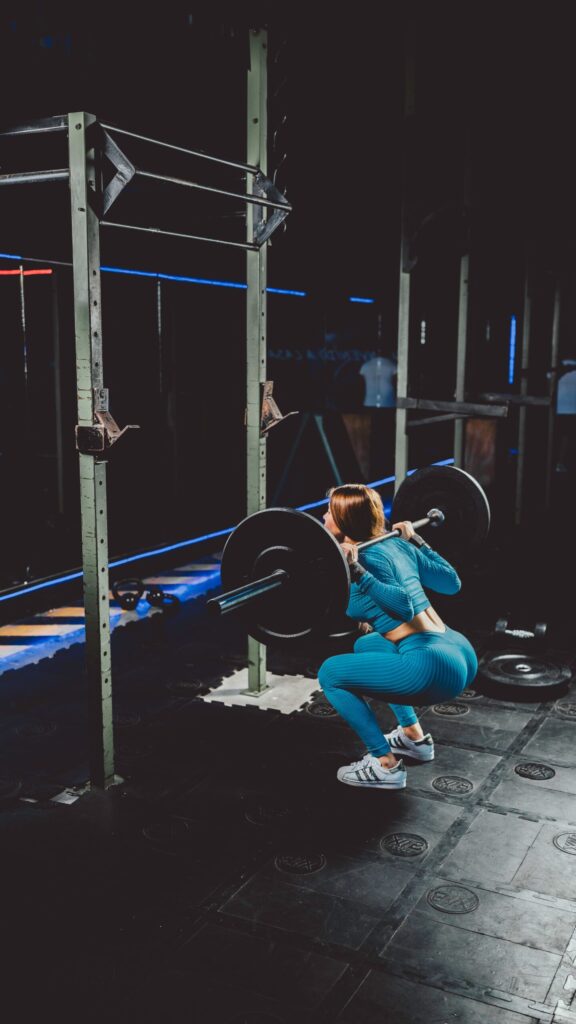
The squat is the most fundamental human movement. You do it every time you sit down and stand up. Training it properly builds the legs and glutes — the largest muscles in your body — which has the biggest impact on your metabolism and daily energy.
How to do it:
- Stand with feet slightly wider than hip-width, toes pointed slightly outward
- Extend your arms straight in front for balance
- Push your hips back like you are sitting into a chair
- Lower until your thighs are parallel to the floor — or as low as you comfortably can
- Keep your chest up and knees tracking over your toes — never caving inward
- Push through your heels to stand back up
Incline Push-Up
Builds: Chest, shoulders, arms, core
Most beginners cannot do a full push-up — and that is completely fine. The incline push-up uses an elevated surface to reduce the load, letting you build the exact same muscles with proper form. As you get stronger you lower the surface until you reach the floor.
How to do it:
- Place your hands on a sturdy elevated surface — kitchen counter, table, or sofa arm
- Walk your feet back until your body forms a straight line from head to heels
- Keep your core tight — do not let your hips sag
- Lower your chest toward the surface by bending your elbows
- Elbows should stay at roughly 45 degrees from your body — not flared straight out
- Push back up to the starting position
Glute Bridge
Builds: Glutes, hamstrings, lower back protection
If you sit for most of the day your glutes are almost certainly weak and inactive. Weak glutes are the root cause of most lower back pain and poor movement patterns. The glute bridge is the safest most effective way to wake them up — and it requires zero fitness to start.
How to do it:
- Lie on your back with knees bent, feet flat on the floor hip-width apart
- Arms by your sides, palms down
- Push through your heels and lift your hips toward the ceiling
- Squeeze your glutes hard at the top — hold for 2 seconds
- Lower slowly with control
- Do not let your hips rest fully on the floor between reps
Dead Bug
Builds: Deep core stability, spine protection, coordination
Forget crunches and sit-ups. The dead bug is what physiotherapists actually prescribe for building real core strength. It trains your deep core muscles to stabilise your spine while your limbs move — which is exactly how your core works in real life.
How to do it:
- Lie on your back with arms extended straight up toward the ceiling
- Lift your knees so hips and knees are both at 90 degrees
- Press your lower back gently into the floor — it should stay there the entire time
- Slowly extend your right arm behind your head and your left leg forward simultaneously
- Stop just before they touch the floor
- Return to start and repeat on the opposite side
Walking
Builds: Cardiovascular fitness, fat burning, daily habit foundation
Yes — walking counts. In fact for a complete beginner walking is the most underrated exercise in existence. It burns calories, builds cardiovascular fitness, requires zero recovery time, and is joint-friendly enough to do every single day. Most beginners who fail at fitness tried to run before they could walk consistently.
How to progress it:
- Week 1-2 — walk 15 minutes daily at a comfortable pace
- Week 3-4 — increase to 25 minutes daily
- Week 5-6 — 30 minutes with 5 minutes of brisk walking mixed in
- Week 7-8 — 30 minutes alternating 3 minutes brisk and 3 minutes comfortable
- From there — you have built the base for Japanese interval walking
Your Complete Beginner Weekly Plan
| Day | Workout | Time |
|---|---|---|
| Monday | All 4 strength exercises + 15 min walk | 30 min |
| Tuesday | Walk only | 15-30 min |
| Wednesday | All 4 strength exercises + 15 min walk | 30 min |
| Thursday | Walk only | 15-30 min |
| Friday | All 4 strength exercises + 15 min walk | 30 min |
| Saturday | Longer walk — enjoy it | 30-45 min |
| Sunday | Full rest | — |
The 5 Rules That Determine Whether You Succeed
- Never miss twice — missing one workout is life. Missing two in a row is the beginning of quitting. If you miss a day the next day is non-negotiable.
- Progress by small increments — add 1-2 reps per week. Not 10. The people who progress slowly are the ones still training a year later.
- Soreness is normal — pain is not — muscle soreness 24-48 hours after training is expected. Sharp pain during exercise means stop.
- The workout you do beats the workout you plan — a 10 minute session on a tired day is infinitely better than a skipped perfect session.
- Give it 8 weeks before judging — visible changes take 6-8 weeks minimum. The people who quit at week 3 never find out it was about to start working.
Research reference: A study published in the European Journal of Social Psychology found that new habits take an average of 66 days to become automatic — not the commonly cited 21 days. This is exactly why the first 8-10 weeks of any exercise programme matter more than the specific exercises chosen — consistency during this window is what separates people who transform from people who quit.
Source: Lally P, et al. How are habits formed: Modelling habit formation in the real world. Eur J Soc Psychol. 2010.
Starting From Zero? Know Your Numbers First
Before you start any fitness journey find out your BMI, daily calorie needs and ideal weight — free, no signup, takes 30 seconds.
Get My Numbers Free →📖 Related Articles
References
- Lally P, et al. How are habits formed: Modelling habit formation in the real world. Eur J Soc Psychol. 2010.
- Garber CE, et al. ACSM position stand on the quantity and quality of exercise. Med Sci Sports Exerc. 2011. NIH/PubMed.
Disclaimer: Robin is a fictional character created for educational purposes. This article is for informational purposes only and does not constitute medical advice. Always consult a qualified healthcare professional before starting a new exercise programme.