
Something changes after 40. Recovery takes longer. Old injuries start talking back. Movements that used to feel automatic suddenly need a warm-up first. None of that means you are falling apart — it means your training needs to shift from “harder” to “smarter.”
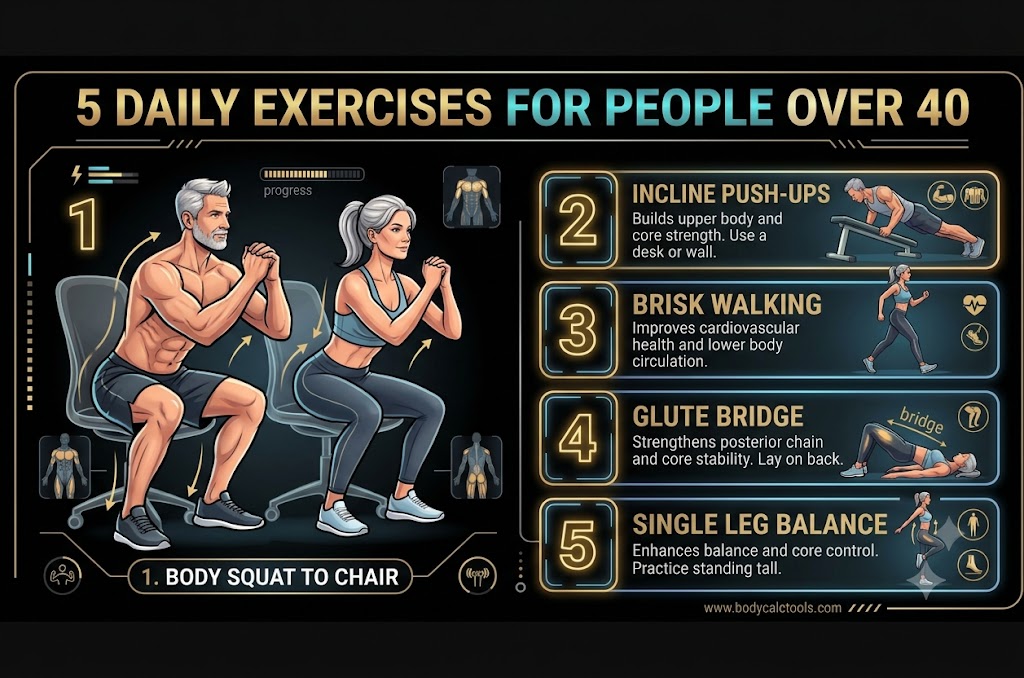
These five exercises are not about chasing personal records. They are the five that give you the biggest return for people over 40 — protecting your joints, preserving the muscle you have left, and keeping you capable of the things that actually matter — carrying groceries, getting up off the floor, playing with grandkids, staying independent for decades.
Maya — 38F, Approaching 40, Desk Job
Maya noticed her recovery from workouts had slowed noticeably compared to her 20s. A gym session that used to leave her fine the next day now left her stiff for two. Rather than training harder she restructured her week around these five movements — and within six weeks her joints felt better than they had in years, not worse.
Why Training Needs to Change After 40
- Muscle loss accelerates — from age 30 you lose roughly 3 to 5% of muscle mass per decade without resistance training, and this rate speeds up further after 40
- Joint cartilage thins with age — high impact movements that were fine at 25 put more cumulative stress on joints at 45
- Recovery capacity drops — growth hormone production declines with age, meaning the same workout takes longer to recover from
- Balance and coordination decline gradually — starting in the 40s if not actively trained, raising fall risk significantly later in life
- Bone density starts declining — particularly relevant for women approaching and past menopause
Source: tracked cohort study on strength training and long-term health outcomes, 2026.
Bodyweight Squat to Chair
Why it matters after 40: The ability to sit down and stand up without using your hands is one of the strongest predictors of independence in later life. This exercise trains exactly that movement while being far gentler on the knees than a deep gym squat.
How to do it:
- Stand in front of a sturdy chair with feet hip-width apart
- Lower yourself down with control until you lightly touch the seat
- Do not fully sit — keep tension in your legs
- Push back up to standing through your heels
- Keep your chest up throughout the movement
Wall or Incline Push-Up
Why it matters after 40: Upper body pushing strength declines faster than most people realise once training stops. This exercise maintains chest, shoulder and tricep strength — and shoulder health specifically — without loading the joint the way a full floor push-up or heavy bench press can.
How to do it:
- Place your hands on a wall or sturdy elevated surface, slightly wider than shoulder-width
- Step back so your body is at an angle, core engaged
- Lower your chest toward the surface, elbows at roughly 45 degrees
- Push back to the starting position with control
- Lower the surface height over time as strength improves
Single Leg Balance
Why it matters after 40: Balance training is one of the most overlooked exercises at any age, but it becomes genuinely important from 40 onward. Falls are one of the leading causes of serious injury in older adults, and balance ability starts declining gradually well before it becomes obvious.
How to do it:
- Stand near a wall or counter for safety if needed
- Lift one foot slightly off the ground
- Hold your balance for as long as comfortable, aiming to build toward 30 seconds
- Switch to the other leg
- Progress by closing your eyes briefly, or standing on a slightly uneven surface like a folded towel
Hip Hinge (Glute Bridge or Romanian Deadlift Pattern)
Why it matters after 40: Lower back pain becomes far more common from this age onward, largely because glutes weaken from years of sitting while the lower back compensates for movements it was never designed to handle. Learning to hinge from the hips rather than the lower back protects the spine for every lifting task in daily life.
How to do it (glute bridge version):
- Lie on your back, knees bent, feet flat on the floor
- Push through your heels and lift your hips toward the ceiling
- Squeeze your glutes hard at the top, hold 2 seconds
- Lower with control
- Focus on feeling the movement in your glutes, not your lower back
Brisk Walking
Why it matters after 40: Cardiovascular fitness becomes an increasingly important predictor of long-term health from this age onward, and walking remains one of the safest, most sustainable ways to build it — with essentially zero joint impact risk compared to running.
How to progress it:
- Start with 20 to 30 minutes at a comfortable pace, most days of the week
- Once consistent, introduce short bursts of faster walking
- Consider interval-style walking — alternating pace every few minutes — once a base level of fitness is built
- Walking outdoors also supports bone density through light weight-bearing impact
The Complete Weekly Structure
A realistic way to fit all five into a week without overtraining:
| Day | Focus |
|---|---|
| Monday | Squat to chair, push-up, hip hinge + walk |
| Tuesday | Walk + balance practice |
| Wednesday | Squat to chair, push-up, hip hinge + walk |
| Thursday | Walk + balance practice |
| Friday | Squat to chair, push-up, hip hinge + walk |
| Saturday | Longer walk, enjoy it |
| Sunday | Rest, or light stretching |
Common Mistakes People Over 40 Make
- ❌ Skipping strength training entirely — cardio alone does not prevent muscle loss
- ❌ Copying a 25-year-old’s programme — recovery needs and joint tolerance are genuinely different
- ❌ Ignoring balance work — it feels unnecessary until it suddenly matters
- ❌ Training through sharp pain — soreness is normal, sharp joint pain is not
- ❌ Doing nothing because “it’s too late to start” — research consistently shows meaningful strength and mobility gains are achievable starting at any age
The Nutrition Side — Protein Matters More Now
Exercise alone is not enough to preserve muscle after 40. Research consistently shows that people in this age group need higher protein intakes than younger adults to get the same muscle-preserving benefit — your body becomes less efficient at using protein for muscle repair as you age, so more is required to trigger the same response.
Find Your Protein Target for Muscle Preservation
Use our free Protein Calculator to find exactly how much protein you need based on your age, weight and activity level.
Calculate My Protein Target Free →The Bottom Line
- Training after 40 is about smart consistency, not maximum intensity
- These five movements cover strength, balance, joint health and cardiovascular fitness in under 20 minutes a day
- Balance training is one of the most overlooked but important additions at this age
- Protein intake needs to rise alongside consistent training to actually preserve muscle
- It is genuinely never too late to start seeing real results
📖 Related Articles
Disclaimer: Maya is a fictional character created for educational purposes. This article is for informational purposes only and does not constitute medical advice. Always consult a qualified healthcare professional before starting a new exercise programme, particularly if you have existing joint issues or health conditions.